Executive Summary (For Founders & Decision-Makers)
Automation in 2026 is no longer optional for SMBs. The difference between a business that scales and one that stalls often comes down to backend systems — not marketing.
This guide outlines a practical, scalable automation stack designed to:
- Eliminate manual bottlenecks.
- Reduce operational overhead.
- Improve data consistency.
- Increase response speed.
This is not about tools. It is about infrastructure.
The Strategic Reality: Tools Without Process Fail
Most SMB automation attempts fail because:
- Tools are purchased before workflows are defined.
- No one owns system architecture.
- Data flows are unclear.
Before selecting software, define your Core Path: Where leads enter, where customer data lives, what actions trigger fulfillment, and what requires human intervention.
- Rule of Thumb: Automation amplifies clarity — and exposes chaos.
Layer 1: The Orchestration Engine (The Brain)
Every scalable stack needs a central workflow controller.
Recommended: Make.com
Make.com serves as the automation architect. Unlike simpler tools, it allows for deep conditional logic, branching workflows, and complex data transformation.
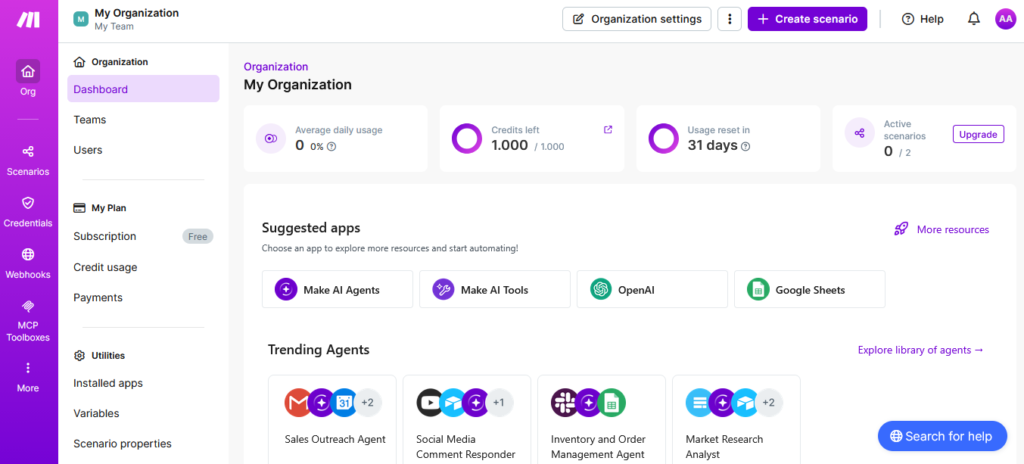
- Caption: Visual workflow orchestration using Make.com.
- Alt text: Make.com automation scenario builder for SMB operations.
Role in the Stack:
- Trigger management.
- Data routing & filtering.
- Cross-platform synchronization.
Strategic Advantage: Lower long-term cost compared to “high-task-tax” platforms when scaling structured workflows.
Layer 2: Lead Capture & Conversion Engine
You need structured lead acquisition that doesn’t rely on manual follow-ups.
Recommended: Systeme.io
Systeme.io acts as the front-end growth engine. It centralizes landing pages, email marketing, and automation sequences in one dashboard.
- Why It Fits SMBs: Low cost barrier and minimal technical overhead.
- Trade-off: This is not the most customizable system, but it is the most cost-efficient launch engine in 2026.
Layer 3: The CRM Layer (Customer Memory)
Automation without a CRM is “blind execution.” You need structured pipeline visibility.
- Option A: Pipedrive (Best for sales-driven SMBs needing visual pipelines).
- Option B: HubSpot Starter (Best for marketing-led growth and segmentation).
Automation Tip: Use Make.com to push every lead from Systeme.io into your CRM instantly. No manual data entry, no missed opportunities.
Layer 4: Data Sync & Backup Layer
Even strong systems need redundancy.
Optional Tool: Pabbly Connect
Pabbly can serve as a cost-controlled backup or for data sync in non-critical flows. It is ideal for teams managing predictable workflows without high per-task pricing.
Efficiency Comparison Table (2026)
| Layer | Recommended Tool | ||
|---|---|---|---|
| Orchestration | Make.com | Workflow Architecture | Medium / High |
| Lead Engine | Systeme.io | Funnel + Email | Low / Medium |
| CRM | Pipedrive / HubSpot | Sales Pipeline | Medium |
| Backup | Pabbly Connect | Fixed-Cost Workflows | Medium |
How to Build This Stack (Step-by-Step)
Phase 1: Lead Engine Deployment (Days 1–7)
Create your landing page and connect it to a structured automation flow. Every new lead is instantly captured, confirmed via email, enriched with AI-generated insights, and stored in your CRM — ensuring no opportunity is lost and every contact is actionable.
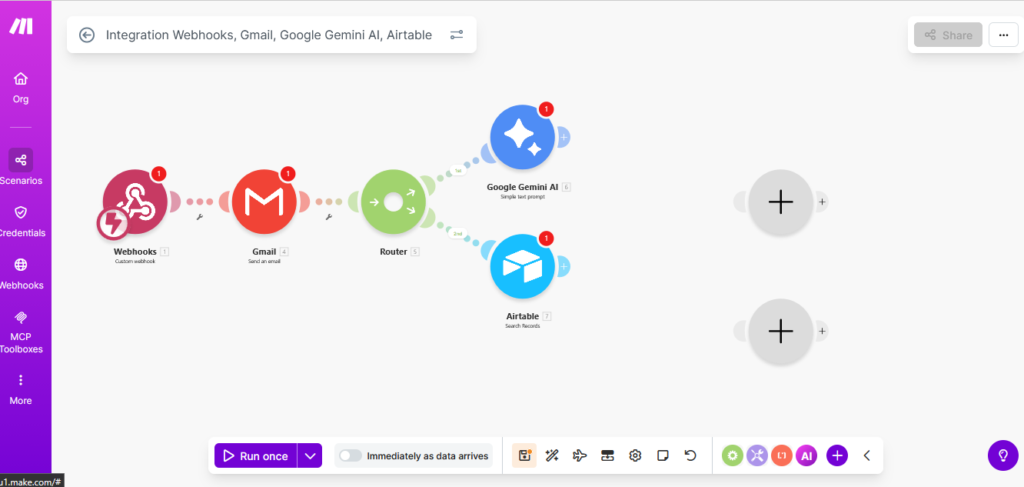
- Caption: Example lead capture and email nurturing flow.
- Alt text: SMB automation lead flow diagram.
Phase 2: System Integration (Days 8–15)
Using Make.com, connect your lead source to your CRM. The system should automatically:
- Detect a new lead.
- Check for duplicates.
- Notify the team via Slack/WhatsApp.
Phase 3: Intelligent Scaling (Day 30+)
Introduce AI via Make to auto-summarize inbound inquiries or pre-score leads. AI should assist humans — not replace them.
Cost Analysis: Automation vs. Human Labor
Typical Stack Cost:
- Make: $10–$29
- Systeme.io: $0–$27
- CRM: $14–$30
- Estimated Monthly Total: $80–$150 for early growth stage.
Compare to: A full-time admin salary ($3,000+ per month). Automation reduces repetitive labor by 70–90%. The ROI is operationally significant.
Where This Stack Breaks Down
This stack is not ideal if:
- You operate in high-level enterprise compliance environments.
- Your workflows change daily (lack of process).
- You lack a defined operations owner.
Final Verdict: Start Lean, Scale Infrastructure
The smartest SMBs in 2026 will not be those with the most tools, but those with the cleanest workflow architecture. Start with lead capture and CRM integration, then scale your orchestration.